The lace that suits your style is the one whose pattern size, density, and placement support the desired silhouette. Small, closely spaced motifs create a more solid overall effect; larger, individually placed flowers leave more of the calm background visible.
For a vintage wedding dress, decide on the line of the silhouette first and then on the amount of lace. A clean neckline with delicate trim creates a different impression from a fully patterned bodice with a softly flared skirt.
The essentials at a glance
| Pattern density | Consider open spaces and solid areas separately. |
| Contrast | Always assess the lace together with its underlay. |
| Silhouette | Coordinate the neckline, waist transition, and hem. |
| Detail check | Compare the full view, close-up, and back view. |
Rule of thumb: The 3-view rule: For every favorite, first check the overall silhouette, then a close-up of the lace, and finally the back. A single detail photo cannot replace this comparison.


Which lace patterns determine the overall look of the dress?
Distinguishing small motifs from larger flowers
First, view a pattern from a little distance. If many small shapes are distributed evenly, the surface appears cohesive. Individual larger flowers stand out more clearly and draw the eye to specific areas of the bodice or skirt.
Then zoom in and check whether you also like the spaces between the motifs. A motif may look appealing in a close-up, while its repetition across the entire dress may appear busier than you would like for your style.
Describe your preference as specifically as possible: a delicate all-over pattern, large flowers on the bodice, or a few motifs at the hem. This allows you to compare two styles meaningfully, even if both are simply described as romantic lace dresses.
Balancing dense areas with calm spaces
The amount of lace and the size of its motifs are two different things. Even a small pattern can look dense if very little of the background remains visible. Conversely, large appliqués with generous spacing can create a clear, well-balanced overall impression.
If you want a clearly defined waistline, pay particular attention to the transition between the bodice and skirt. A solid expanse of lace emphasizes this area differently from individual motifs that flow downward across the seam.
For an initial selection, a simple comparison can help: mentally cover up the embellishments and background on the screen. If the desired silhouette remains clearly recognizable, the lace distribution is already contributing to a cohesive impression on its own.
View the underlay and lace color together
Lace always works in combination with the fabric beneath it. When the two shades are close to each other, the pattern appears more subtle. A stronger contrast makes flowers, vines, or geometric shapes more visible and changes the look of the entire surface.
Therefore, do not compare isolated color names. A light lace motif over a warmer underlay can look different from the same motif on a similarly light background. What matters is the combination shown and described for the specific version.
Keep your other choices consistent at first. If you change the underlay, neckline, and skirt width at the same time, it is difficult to tell which detail you actually like. Whenever possible, compare two similar silhouettes first.
How do lace and a vintage silhouette work together?
Use the neckline as a clear boundary
At the neckline, it is especially noticeable whether the lace follows the contour or extends beyond it. An even edge creates a clear line. Individual motifs that extend beyond the edge make it appear softer and can make the neckline look less strictly defined.
For transparent areas, check where the opaque underlay actually ends. The visible lace edge and the neckline beneath it do not necessarily have the same shape. In a small preview image, these two lines can easily appear to merge.
If you plan to wear a particular necklace, consider it as part of the look from the outset. A richly patterned upper area does not automatically need additional details. Decide whether you want the eye to be drawn to the neckline, the lace motif, or the jewelry.
Check the waist transition and skirt width together
A fitted bodice with a flared skirt makes the waist transition clearly visible. Here, the lace can create a defined boundary or flow softly into the skirt. Both solutions work; they simply tell a different story through the lines of the silhouette.
With a minimalist skirt, a richly detailed bodice stands out more strongly. If the pattern continues to the hem, the entire length becomes part of the lace design. Decide consciously whether you prefer a focal point or a continuous surface.
Do not confuse a flowing pattern transition with the absence of a waist seam. Appliqués can conceal a structural seam. For the fit, it remains important where the bodice ends and at what point the skirt gains its fullness.
Include the back and hem in your decision
The back should not be considered only after viewing the front. A densely patterned front with a dramatically open back creates a different effect from a bodice with a similar design all around. Check whether this balance matches the overall look you want.
At the hem, pay attention to whether the pattern ends evenly, forms a curved edge, or decorates only certain areas. An emphasized hem draws the eye downward. Together with a train, it can create a clearly visible second focal point.
Vintage-inspired describes the design aesthetic here, not the age of the garment. Lace alone proves neither a specific era nor a historical origin. For your selection, the visible construction and product description are more informative.
What matters when it comes to details and wearing comfort?
Consider contact points and transparency carefully
Make a note of where the lace might lie directly against the skin, such as at the neckline, arms, or back. An image shows the arrangement, but it cannot reliably convey how it will feel on your skin. Visible texture and actual softness are two separate considerations.
Also check which areas are lined. A patterned area may appear solid in the photo even though there are transparent sections between the motifs. Use different views and the construction details provided for the specific style to assess this.
During a fitting, move your arms forward, sit down, and gently twist your upper body. Check whether an edge pulls, a sheer insert shifts, or a seam presses. A beautiful lace design does not replace this practical test.
Distinguish relief, trim, and other surface details
Not every bright spot in a product photo is a bead or sequin. Light reflections and raised embroidery can look similar. Only describe a detail as additional trim when it is clearly identifiable in the description or close-up.
Also compare the lace with the veil and other fabrics you plan to wear. Two striking patterns can compete with each other. A quieter complement allows the selected lace structure to stand out more clearly, without every piece needing to feature exactly the same motif.
When several details come together, establish an order: start with the bodice, then consider any glossy accents, and finish with the accessories. This makes it easier to see which element shapes the overall impression and which details you might forgo in another style.
Derive care instructions from the details of the finished dress
Lace alone is not sufficient care information. The finished dress also includes lining, seams, and possibly additional embellishments. Therefore, do not automatically apply the treatment used for a previous lace dress to a new style with a different construction.
GINETEX explains: The fiber composition alone does not determine the care requirements. Check the care label of the specific dress before treating it.
Keep the available information together with your style notes. If a professional assessment is needed later, details about the entire dress will be more helpful than a single keyword such as lace. When in doubt, do not decide based on appearance alone.
How do you compare vintage details at babyonlinedress?
Note the same features for each favorite
Start your search through the bridal dresses at babyonlinedress with a short list of features: pattern size, density, lining, and the transition at the waist. For each favorite, add only what the corresponding product page actually shows or explicitly describes.
An entry such as large flowers on the bodice and a simple skirt is more helpful than the note beautiful and romantic. It makes clear why a style remains on your shortlist. When comparing later, you will not have to reconstruct your initial reaction from memory.
If an important view is missing, leave the relevant point blank. A presumed back design or fabric characteristic is not a reliable basis for comparison. For now, focus on styles whose key details you can understand and verify.
Use full-length and detail shots differently
The full-length image answers the question of silhouette. The detail shot shows the visible lace pattern. Consciously switch between the two instead of simply zooming in further and further. A beautiful individual motif must also work within the overall silhouette.
Pay attention to differences in lighting and poses. A turned upper body can make motifs appear closer together, while side lighting can emphasize the texture more strongly. Do not immediately interpret every photographic variation as a difference between two fabrics.
The styles below are reference points for visible details, not historical classifications. In each case, identify which feature interests you. You can then search more specifically for a similar pattern distribution or a simpler alternative.
Make a decision with clear priorities
Finally, define one indispensable feature, such as a clear waistline or a subtle lace trim. Then choose two additional preferences. This simple ranking prevents one striking detail from overshadowing all your other requirements.
If two favorites remain, compare the exact point where they differ. Is it the density on the bodice, the back view, or the emphasis on the hem? A specific question will usually take you further than looking at all the details again at once.
Your vintage wedding dress does not have to recreate a complete historical wardrobe. What matters is that the pattern, silhouette, and personal feel when worn work well together. A deliberately chosen lace design can convey the desired style even when the other elements remain simple.
Matching dresses from our shop
Strapless vintage wedding dress – with a lace bodice.
Vintage wedding dress with sleeves – with lace.
Black wedding dress – with lace sleeves.
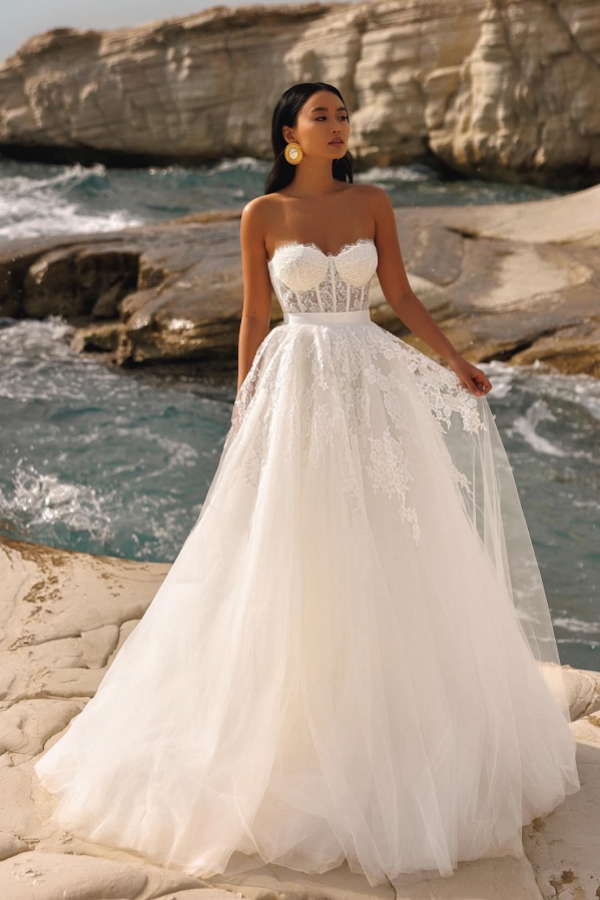
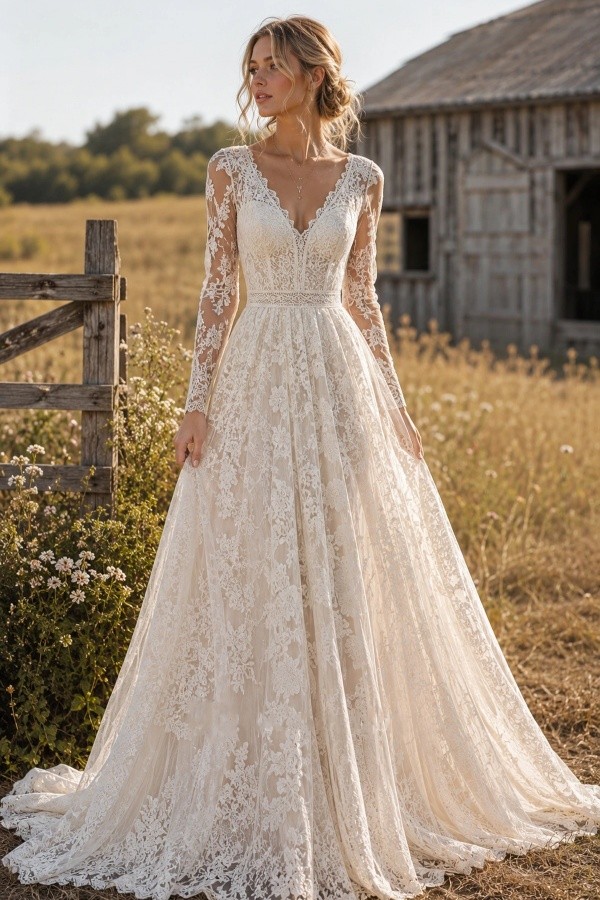

Wedding dress with lace sleeves – in an A-line silhouette.
Vintage wedding dress with a train – with a lace bodice.
V-neck wedding dress – with lace.

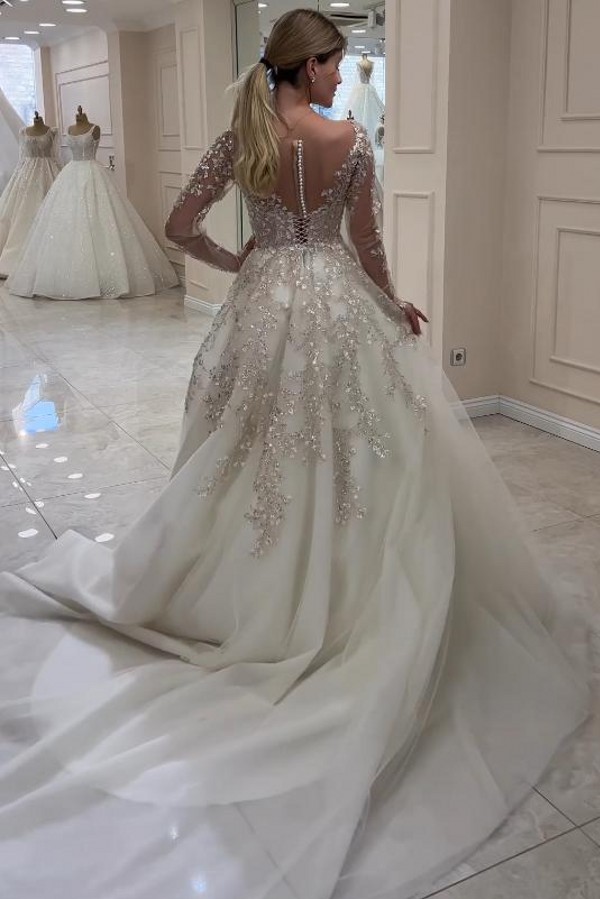

Find the complete selection under Wedding Dresses.
Find the complete range at Babyonlinedress.de.
If you would like to distinguish vintage and boho styles more precisely, the article on recognizable boho silhouettes complements the selection.
Frequently asked questions
Which lace looks subtle on a vintage wedding dress?
A tone-on-tone lined pattern with calm areas of negative space often looks subtle. In addition to the motif size, the distribution is the main factor determining the impression of the entire dress.
Why does the same lace look different on different dresses?
The underlay, placement, and lighting change the way the lace appears. A stronger color contrast makes the motifs stand out more clearly than an underlay with a similar brightness.
How can I identify the actual neckline beneath the lace?
Check where the opaque underlay ends. Its edge may follow a different line from the lace edge above it and is easier to identify when viewed from multiple angles.
What should I check when trying on a lace dress?
Check the contact points against the skin, seams, and neckline while moving as well. Sitting down, reaching your arms forward, and turning slightly can reveal potential pressure points or inserts that shift out of place.
How can I tell whether a vintage bridal gown is historically authentic?
A lace look alone proves neither the age nor the historical origin of a dress. In this guide, vintage-inspired refers to a design aesthetic, while the product details describe the specific model.
Where should I start when choosing a vintage bridal gown?
Start by browsing the bridal gowns on babyonlinedress and comparing the pattern size, underlay, and contours. A short list using these same characteristics makes the differences between your favorites easier to understand.
About the Author
Lisa Müller writes the babyonlinedress guides on bridalwear, eveningwear, and fit. She explains how the cut, fabric, and visible details work together when choosing a dress.